Back to Why One-to-One Memory Coaching
🧠 Evidence‑Based Methods for Memory & Cognition
Visualization & Memory (Memory & Cognition, DOI: 10.3758/BF03198291) Research shows that visualisation enhances recall by activating the same neural pathways used in perception, strengthening memory encoding.
Mnemonics & Association (Educational Psychology Review, DOI: 10.1007/s10648-010-9124-y) Mnemonics and associative techniques improve learning efficiency, helping information stick longer and deeper.
Spaced Repetition (Psychological Science, DOI: 10.1111/j.1467-9280.2007.01936.x) Spacing practice sessions over time significantly boosts long‑term retention compared to cramming.
Speed Reading (Applied Cognitive Psychology, DOI: 10.1002/acp.3080) Studies confirm that structured speed‑reading methods can improve comprehension and processing speed when applied correctly.
Brain Health & Cognition (Frontiers in Aging Neuroscience, DOI: 10.3389/fnagi.2014.00003) Lifestyle and brain‑training interventions support cognitive resilience, particularly in aging populations.
🧠 Studies show muscle strength can increase by 35% through imagination - the same principle applies to memory, which is exactly where my work begins.
Scientific research confirms that consistent mental imagery (motor imagery) can increase muscle strength by 13–35%, even without physical movement.
- Little Finger Study (Cleveland): Participants who only imagined flexing their finger gained 35% strength.
- Bicep & Ankle Studies (Texas & Ohio): Adults imagining curls or ankle movements improved strength by 22–36%.
- Athlete Study (Bishop’s University): Mental training alone boosted hip flexor strength by 24%.
These landmark studies prove a simple truth: the brain adapts through rehearsal, even without physical action.
And memory works the same way. Like a muscle, it strengthens with use and weakens with neglect. Mental rehearsal — through memory palaces, shopping list drills, or body‑mapping — activates neural pathways, building recall, focus, and confidence.
This is where my work begins: applying research‑backed mind‑body methods to keep your memory circuits “switched on,” so recall becomes sharper and learning effortless.
🧠Memory Reconsolidation and EFT
Scientific models suggest that when a memory is recalled, it enters a reconsolidation window — a brief period where the brain can modify or update it. Techniques like EFT tapping combine focused recall with somatic stimulation, helping reduce the emotional charge attached to old patterns.
This matters for cognitive ability: by easing stress responses and reframing learned associations, reconsolidation supports clearer recall, stronger focus, and improved confidence in memory tasks.
https://pmc.ncbi.nlm.nih.gov/articles/PMC12671046/
🧠 EMDR for Memory and Cognition
Research shows EMDR can be adapted for clients with impaired cognitive abilities, helping reduce trauma symptoms while supporting memory, attention, and learning.
If EMDR can reprocess trauma under cognitive strain, imagine what it can do to strengthen memory when applied deliberately.
🧠 Neuro‑Linguistic Programming (NLP) for Memory and Cognition
Research, including studies from Greenfield Advance Research, confirms that Neuro‑Linguistic Programming (NLP) can improve cognitive function and reduce stress. By reframing limiting beliefs and using guided imagery, NLP strengthens focus, recall, and confidence - exactly the areas where memory training delivers results.”
🧠 Educational Kinesiology and Cognitive Function in Older Adults
If simple movements can measurably improve cognition, imagine the impact when combined with targeted memory training and mind‑body methods.
Peer‑reviewed research published in ScienceDirect confirms that Brain Gym exercises improve global cognitive function in older adults. By engaging both sides of the brain through simple movements, Brain Gym strengthens attention, recall, and executive function — reinforcing the principle that memory, like a muscle, improves with use.
https://www.sciencedirect.com/org/science/article/pii/S1462373022000219
🧠 Hypnosis: Proven to Reshape Brain, Emotion, and Cognition
Cognitive Neuroscience of Hypnosis (MDPI, 2024) Research shows hypnosis alters brain networks involved in attention, memory, and executive control, with neuroimaging evidence confirming measurable changes in connectivity. DOI: 10.3390/brainsci14010056
Meta‑analysis on Depression & Anxiety (IJCEH, 2018) Hypnosis produced medium to large effect sizes, comparable to CBT, with long‑term benefits for depression and anxiety — showing its impact on both emotional regulation and cognitive resilience. DOI: 10.1080/00207144.2018.1489777
Hypnosis and Cognitive Control (Frontiers in Psychology, 2020) Evidence demonstrates hypnosis can improve executive function and cognitive flexibility, reinforcing its role in enhancing adaptive thinking and problem‑solving. DOI: 10.3389/fpsyg.2020.01628
DOI: https://doi.org/10.3390/brainsci14010056 (doi.org in Bing)
DOI: https://doi.org/10.1080/00207144.2018.1489777 (doi.org in Bing)
DOI: https://doi.org/10.3389/fpsyg.2020.01628 (doi.org in Bing)
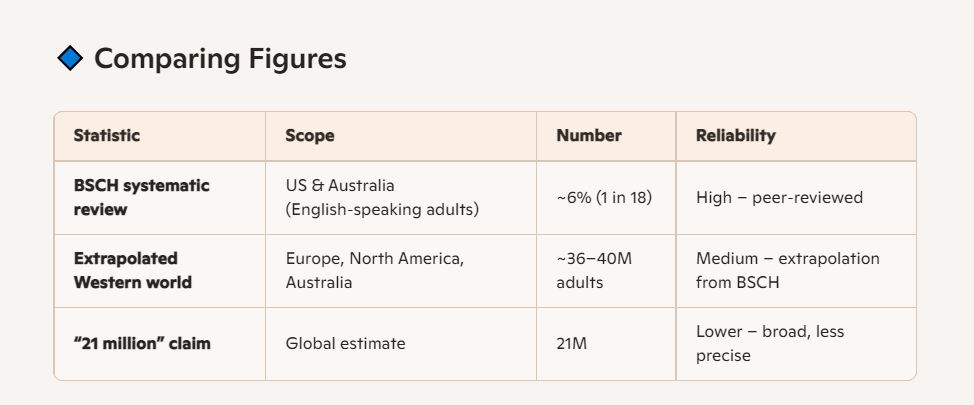
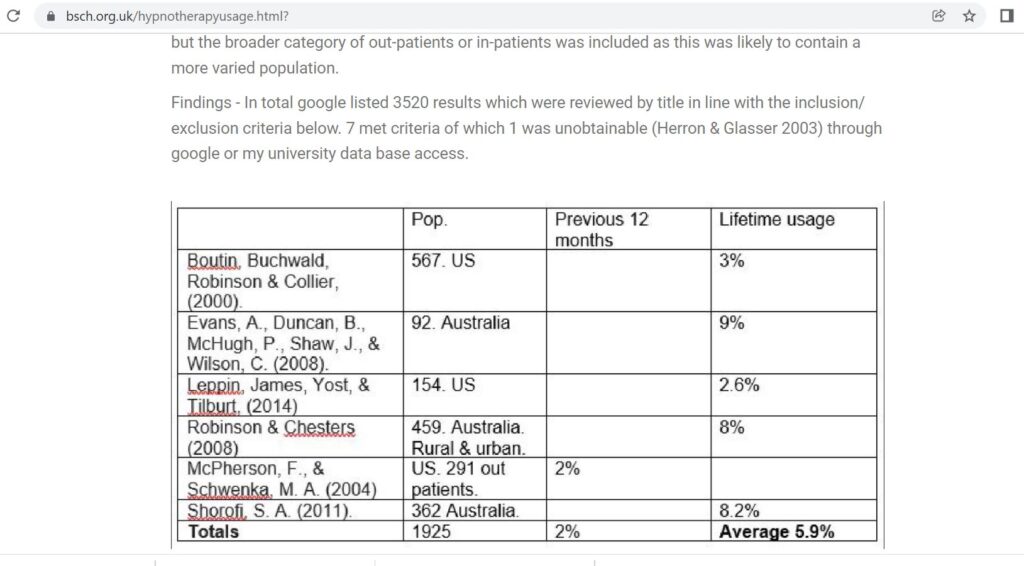
How Many People in the Western World have Experienced Hypnosis